Author: admin (Page 5 of 6)

Searching in the Deeds Registry

I spent a very frustrating afternoon in the Deeds Registry in Wakefield trying to find out more information about our property.  I had high expectations, but it wasn’t to be.  Last time I did some research on local history, I got a result in 30-40 minutes. But this time, I spent all afternoon and got nowhere.

From the census, I knew that at least one of the properties was occupied by Hobsons from 1851 through to 1911 (which is the last available census).  We had already found the Hobsons gravestone in Honley Cemetery, so I was assuming that they might have owned the property.  But alas no.

I searched all of the deeds registers and there are no entries for David Hobson.  In fact, there are no entries under David Hobson (any David Hobson) in West Yorkshire between 1819 – 1919.  Spooky.  There are lots of entries for Hobsons, but none for David Hobson.  I did find some entries under Joseph Hobson, but none of them were the correct Joseph Hobson (or in the wrong area).

I searched under the names of the other occupants that featured in the Censuses, but again no luck.  So I can only surmise that the occupiers did not own the property, but rented them (don’t forget that they are organise as three separate cottages).

Time to change tack.  In 1910, there was a national land survey conducted to establish who owned each plot of land in the UK.  We quickly found the appropriate map in the archive.  Luckily, the map we were looking for was there – the Archive do not have copies of all of the maps.  The map shows that all the cottages and the land surrounding it is owned by the same person – referenced on the map as “1010”.  Unfortunately, I then ran out of time before I could look up the reference number in the catalogues.

Ho hum.  It will have to wait for another day.  But at least we do know that all the cottages and the surrounding land were owned by a single person in 1910.  It is a start.

PS The staff in the Registry of Deeds are really helpful and sure know their way around.  More information here: http://www.archives.wyjs.org.uk/archives-wakefield.asp.  Check the opening times if you want to visit (it is closed at lunchtimes 1-2pm) and I would suggest making an appointment before visiting.

Mobile telephone mast

We have always been aware that there is a mobile telephone mast in the woods above the property.  I realised it was more than a mobile phone mast when I saw the deeds providing access to the mast on behalf of the IBA. 

We walked up into the woods today and had a closer look.  A quick search online proves that it is indeed a television transmitter as well as a mobile phone mast.  More details here: http://www.ukfree.tv/shutdowndetail.php?tx=SE148105

The mast is a few hundred meters from the property and is largely obscured by the woods (certainly in summer with leaves on the trees). 

And I guess the other thing is that by the looks of the map above, we should get great reception of digitial TV. Strangely I have looked through all the photos of the property that we have taken and none of them have got the mast in shot.

Old maps

When I was looking into how old the property was, I used some of the old maps in the Local History Unit in Huddersfield Library.  I have a photocopy of the oldest one that has our property on it – 1788.  The map is well out of copyright so the library was happy for me to photocopy it.

I then wondered about whether old maps ever appeared on ebay.  And the answer is yes.  I found a couple of old maps that show the property – one from 1901 and another from 1938.  The scale on the 1901 map was a little small, but the 1938 map clearly shows the property.  I purchased both maps – £3 for the 1901 map and £12 for the 1938 map.  There are both copies of the originals.

I spotted the one of the sellers had a 1:2,500 map of the area, but unfortunately our property was just off the bottom of the map.  I sent them and email enquiry if they had the adjoining map.  No luck, but I do now know the map number that I am looking for! 

The vendor (Chris @ Wealden Relics.  See the ebay site here) pointed me in the direction of www.old-maps.co.uk.  This site allows you to search on a postcode and then view a number of old Ordnance Survey maps of that location.  The 1:2,500 maps are the most detailed and the most useful.  There are a number available showing our property over the years.  The maps are a little on the expensive side, but you can get a lot out of the site without having to purchase a map.

The Hobson’s gravestone

Found it!  The graveyard was a little overgrown, but this end of the graveyard seemed to have been cleared recently.  The building in the background is not the church, but the chapel mortuary – one of very few to be found in West Yorkshire.  It is boarded up and largely derelict now.

The Hobson’s gravestone is the one to the right of the photograph.  David and Mary Hobson are buried here together with their daughters Ann (Mellor) and Marian, their son Joseph and his wife Mary.

David and Mary lived in the property from at least 1850 through to the deaths in 1882.  Joseph and Marian (their son and daughter), who were both born in the property, lived there until at least 1911 (their latest census records that are publicly available). Joseph died in 1933, Marian in 1899.

Presumably reusing the plot and the gravestone saved on the costs.

Who used to live here…

When I first started looking into how long the property was, I spent a little bit of time in the Local History Unit at Huddersfield library.  Quite quickly I established from the 1901 census that the property (10 Hagg Lane as it was referred to then) was occupied by Smith and Mary Littlewood and their three children (Ernest, Wilfred, and Denis) and a step daughter Evelyn Eastwood. Their occupations were listed as Woollen Weaver.

The property next door (9 Hagg Lane) is occupied by a 50 year old farm labourer, named Joseph Hobson. Originally, I used the microfiche in the local library to view this information, but I have subsequently accessed it online.  Although there is a charge, you can access the information from here: www.1901censusonline.com

There is no 8 Hagg Lane listed on the 1901 census although, 8, 9, and 10 Hagg Lane are clearly shown on many of the old maps (including the 1977 OS version).  Strangely enough, there are only two properties present today number 8 and number 10, but not number 9 and number 10.  This illustrates part of the problem with using the old censuses, particularly in rural areas  – the numbering of properties is a fairly recent occurrence (since Victorian times) and it can be difficult to work out which properties are which.  For example, there are no numbers on the censuses for this property before 1891.  You have to use some intelligence and work out which way down the road the administrator was travelling as he filled in his census forms. In the 1891 census, the properties are identified as “Cliffe, Hagg Lane”.  I am assuming that the “Cliffe” refers to the bit of crag in the bottom field that can be seen from the road.  The 1851 census lists the property as “Middle Hagg”, presumably on the basis that it is between Upper Hagg and Lower Hagg.

Anyway, back to Joseph Hobson who lives in 9 Hagg Lane in 1901.  He is recorded as living in the property in 1861 as a “scholar” 16 years old with the rest of his family.  His parents are David and Mary Hobson (both born in 1809).  His father’s occupation is listed as “Farmer of 6 acres”.  His father is born in Honley and his mother in Farnley Tyas.

So the next thing I wondered about was whether I could find out where they are buried.  I had a quick look at the map and worked out where the nearest churches and grave yards where.  One in Netherthong (I know this church dates from around 1820) and another in Brockholes (dating from around the same time).  I had a quick look in both churchyards, before searching online.

A quick search online showed that there is a graveyard in Honley.  Furthermore, the burial entries have been digitised and are online.  Surely I won’t find the Hobson’s?  Bingo.  Section 30, plot 2269.

You can find the website site here: http://www.honley.ukf.net/ Although, it hasn’t been updated since 2003, it had all the information I was looking for.

Well, you know what I am going to do next – yep, look for the gravestone.

The farm today

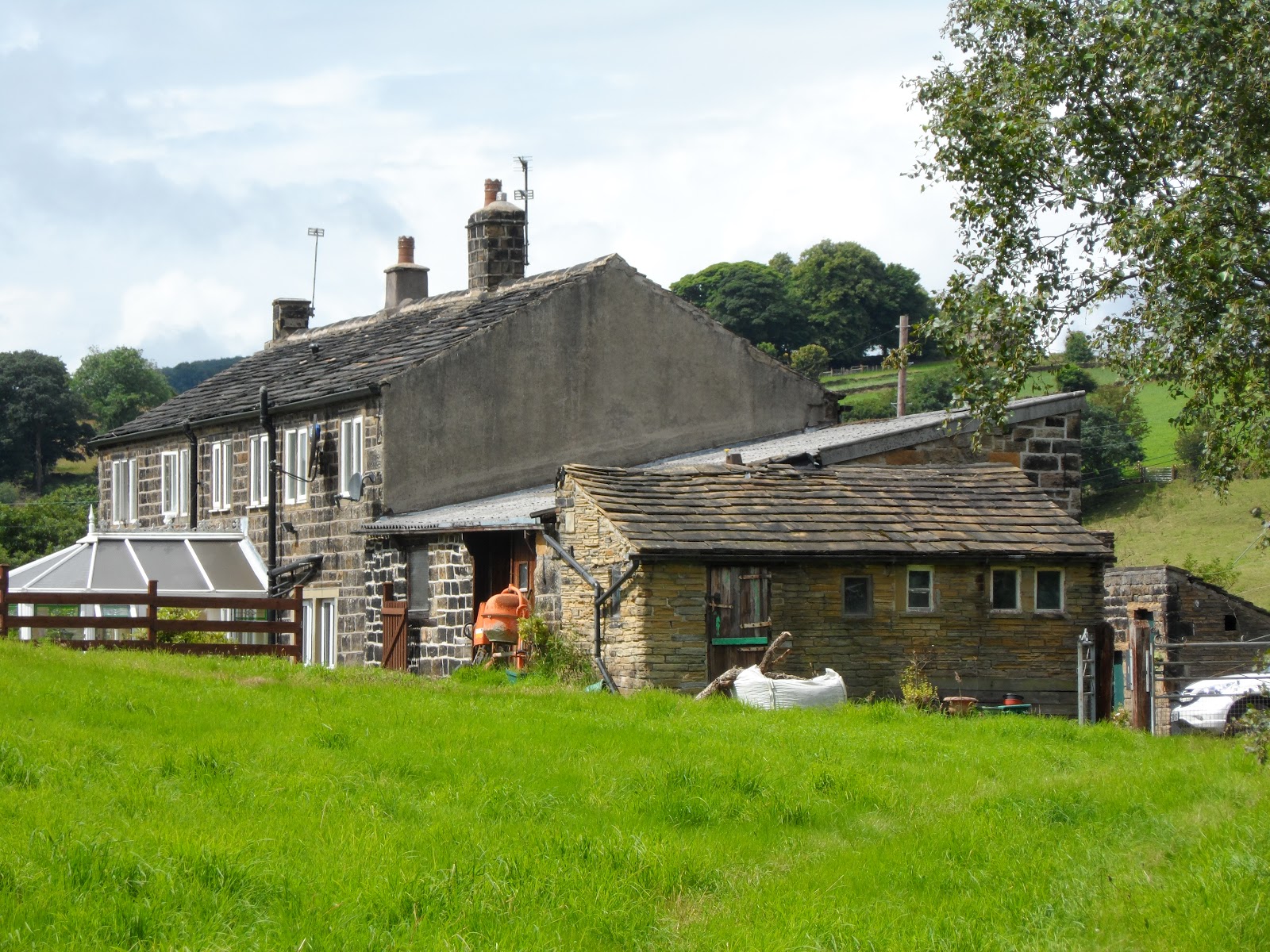
Here’s some photographs of the property as it is today.  It is organised as a small attached cottage, a larger cottage and an unconverted barn.  All on a 2 acre plot of land.

From the road.  The odd shaped building to the right of the picture is a coal hole.  This odd shaped part of the building seems to be fairly original as it appears on even the oldest of the maps that we have found. Take a close look at the 1788 map, particularly where the property adjoins the road. The porch is for the small attached cottage.

From the back of the property.  This is the view from the back of the top field.  The unconverted barn is at this end of the property.  It has clearly been rebuilt in recent years, but is still unconverted.  The lower photograph is the rear of the property, but this time from the bottom field looking up.  The odd shaped appendage is the back of the coal hole seen above.

The unconverted barn.  This has a sloping roof and has two floor levels inside.  The lower floor level is the same level as the ground floor in the adjacent property.

Bat Survey

Bats are a protected species in the UK.  This means that it is a criminal offence to intentionally or recklessly kill or capture, disturb a place of shelter or destroy the resting place of a bat.  A roosting site can be protected even if there are no bats present.  Furthermore, a bat survey needs to be undertaken BEFORE a planning application can be determined.

The other compounding fact here is that the survey can only be completed at suitable times of the year, normally May to September. 

In our case, we are not likely to be submitting a planning application until after September, so if it turns out that we need a bat survey then we will have to put everything on hold until the following May when the survey can be completed.  Not a great result.

Talking to the existing owners, it would appear that there are bats in the area, so we have decided to get a bat survey completed now just in case.  But it is another added expense.  Around £1,000.

How old is the property?

One of the questions that has been bugging me ever since we first saw the property has been it’s age.  Exactly how old is it?

This seems like a hard question to answer – at least, answer accurately.  I am guessing that it was built in the 1800s and I am assuming that some of the interal features might help dated it.  However, often a visit to the Local History unit in the local Library will provide a number of the answers.

Well, I have looked into this will previous properties that I have owned so have an idea about the process.  With this in mind, I visited the Local History unit in Huddersfield central Library.  I was not quite sure how much information I would be able to find – it is very variable depending on the age and area.  However, I was very pleasantly surprised to be able to spot the property on an old map.  First of all, it was definitely there in 1894.  I then looked on the 1854 map and it was there too.  Then onto the oldest map in the library.  And bingo.  It was there too.  In 1788! 

The amazing thing is that the outline of the house really hasn’t changed that much in the past 250 years (it is the “T” shaped building above the letter “A” in “Lower Hagg”.  Just compare the scan from the 1788 map with the image from Google earth on my other posting.  Almost identical.

With the help of the librarians at the library, I looked through the boxes of photos of the area and managed to find an RAF aerial photograph from 1948 that also includes the property. [Incidentally, many of these aerial photographs are available online, however, not the one that I was looking for.  English Heritage maintain and archive of these images online and you can find it here: http://www.britainfromabove.org.uk/.]

A quick through the census for 1901 established that the property (10 Hagg Lane as it was referred to then) was occupied by Smith and Mary Littlewood and their three children (Ernest, Wilfred, and Denis) and a step daughter Evelyn Eastwood.  Their occupations were listed as Woollen Weaver.  The property next door (9 Hagg Lane) is occupied by a 50 year old farm labourer, named Joseph Hobson. The census data can now be accessed online, although I used  the microfiche in the library for this purpose.

All of this I established within a hour, pretty amazing really.

Now to be able to date house any further, I will need to visit the Registry of Deeds in Wakefield.  The Registry of Deeds was established by an Act of Parliament in 1704 to allow land holders to register publicly deeds relating to property.  But this will have to wait for another weekend!

Using Google Earth to work out the layout of the property

One of the challenges with purchasing Hagg Leys Farm is that we do not have any property details.  We bought the property before the details had been produced and once the property had been sold, there was no interest in producing these.  So we are having problems answering basic questions such as “how many sq ft is the property?”, “How big is the garden?” etc.
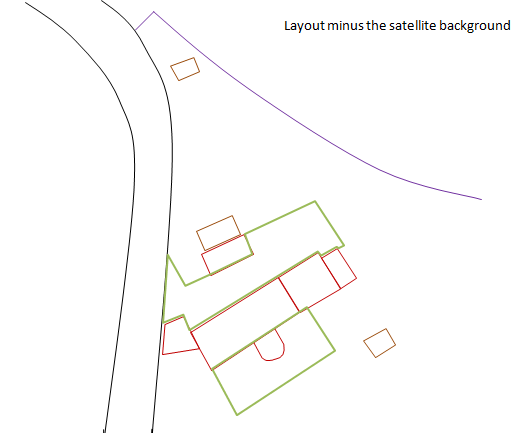
As it turns out, the square footage is an important factor in estimating a number of the basic costs so it is important to be able to get an estimate of this, no matter how rough.  It occurred to me that Google Earth might be a good option here.  I zoomed in on the property as much as I could and grabbed the bitmap (using the snipping tool in Windows 7).  I then pasted this into PowerPoint and drew around the outline of the buildings including other features such as the access road and outbuildings.  You can then remove the underlining satellite image to reveal the outline of the property plan.
Two important things to remember.  Firstly, if you shrink the bitmap, make sure that you keep the proportions the same.  Secondly, when you grab the bitmap make sure that you include the scale.  If you do this, you should be able to mention the outline of the buildings.  Using this approach, I managed to estimate that the square footage of the existing building is around 2700 sq feet (excluding the unconverted barn). I could also start to building some outline designs for the renovation as well as calculating the potential increase in square footage.  I used this to provide some illustrations to the architect and it turned to be a really useful process.

Well, I am glad we shared our ideas first!

Because if we hadn’t, I think the architect would just have thought we had copied his!

We visited one of their latest projects – a renovation project that is currently up for sale.  There were so many similarities with what we want to do, it was spooky.  The bright modern interior inside a period shell, the open planning living that flows from room to room, the master bedroom that is separate from the guest bedrooms etc.

You can see the property here including interior photos and floor plans.

The property is around 2,200 sq ft so probably slightly smaller than our intended renovation.  This fact alone has us wondering about whether the overall size of our renovation is too big.  But it is still early days.

In the afternoon, we had a look at another property.  Different location. New build, rather than renovation and a lot bigger. You can see more of this property here.  Not really our sort of thing, but interesting from a design point of view, if nothing else.

« Older posts Newer posts »

© 2025 Hagg Leys Farm

Theme by Anders NorenUp ↑