Page 63 of 67

Dry stone walling – Day 5

Day 5 and the first section of wall is now finished. Yes, I know, it is only 2 metres long, but it does give an indication of what the finished wall will look like.

I was watching the weather forecasts this week and today was a cracker.  And with some holidays to use up at work, it was too good an opportunity to turn down. With one final push, I thought I might be able to finish this section.  With an early start, I was putting the coping stones on just after lunch.


First section of wall completed

It is difficult to think that it has taken 5 days over the last month to get this far.  I can’t help, but look at it and see all the imperfections.  However, I wonder what I would have thought of this a month ago before I started building my first dry stone wall.
 
Seeing a completed section is a real boost to both my enthusiasm and confidence.  It was surprising how quick the top half of the wall was to completed, compared to the bottom half.  I reckon the top half and the coping stones took 1 day, the foundations and the bottom half took 4.  However, I suspect I will now speed up given the enthusiasm engendered by finishing this first section.
 
The wall from the other side – ground level on this side of the wall is lower
I have looked back on the original posts (I started on this wall at the end of September) and reflected on what I had learnt……



Clearing out the orchard

I have spent the past couple of weekends clearing out much of the undergrowth and old trees from the orchard.  I haven’t cut down any of the fruit trees, but I have taken out the other trees that had grown in between.  It must have been years since any of this land was cared for.  I can’t believe how much I have taken out  of such a small piece of land.  This space looks so mucher bigger now.  I have left all of the sheds in place (for now) – there are two fairly large sheds here.

Stihl 017 Chainsaw – Newly Serviced!


I did get my chainsaw serviced during the week and this has made a tremendous difference.  Rapid Hire Centre in Honley (my local Stihl dealer) serviced it same day as well as fitting a new chain.  I notice that they have also turned the guide bar over so it wears equally on each side (hence the Stihl logo on the guide bar is now upside down). They have done a great job and are local – very local.  Shame their website doesn’t mention that they are a Stihl dealer plus their latest catalogue is 2010.

I am not a great fan of chainsaws. Pretty dangerous and things can go spectacularly (and disastrously) wrong if you aren’t careful.  They need to be treated with care and respect.  I tend to plan the cuts, clear the area, make the cut and then turn the chainsaw off before clearing the area and starting the process all over again.  This means that the work is slow and methodical, but it also means that there is no debris in the area to trip over (I don’t even want to think about falling over carrying a running chainsaw!).

There’s probably another day or so’s work here to tidy things up.  As well as the over grown trees in the orchard, there is a large tree in the one corner with what appears to be storm damage.  This needs tidying up.  I made a start, but the light was fading fast.

The smaller upper branches are now on a rather large bonfire.  The more substantial pieces have been cut up into logs.  It will be a year or so before they are ready to burn, but I am sure that I can find a good home for them!

So where is the well?

Apparently, none of the cottages were on the mains water supply until the 1970’s.  Until that point, water was collected from a spring 200m down the road using a barrel and a well barrow!  Seems a bit difficult to believe in this day and age when we take running drinking water for granted.

But there is something here that doesn’t stack up.  Why would someone in the 1750’s build three cottages where there was no water supply?  It is fairly common for old properties in the area to have their own well.  Often very deep – 40-50ft would not be unusual.  But there is no sign of a well on the property at all today.

So where might it have been?  I can’t imagine that it would have been at the rear of the property since there is no sign of any doors or access on that side.  I can’t imagine that it is going to be directly in front of the cottages as this area forms a sort of farmyard. The access has not changed over the years so it looks like it has always been a farmyard.

So the only other option is that it has to be located some where in the front of the property, beyond the farmyard, and in (what is now) the orchard.  But still no sign.  But it must be there somewhere.  Surely.

Rear of the property: Photosynth

Here’s some more images of the property as it is today.  You will have seen photos of the property elsewhere on the site (see here), as well as the architects drawings of the existing elevations (see here).  However, the below image is a pseudo 3D view produced using Microsoft Photosynth.  The image below will allow you to scroll left-right as well as up-down.

There was taken on an early (and view cold October) morning.  The sun is very strong and you can see my shadow in the foreground of the image. This image was constructed using Photosynth running on an iPod Touch.

You may need to install Microsoft Silverlight to be able to view the image.

Adding keywords to blogspot

One of the things that I wanted to do recently was add keywords to this blog so that it is more easily listed by the search engines.  I had assumed that there was going to be a simple way of adding these in the blogspot control panel.  Unfortunately not.  It needs to be done manually.  Here’s how.

1. First, sign in to blogger; at Dashboard, click “Layout” tab; then click “Edit HTML”.
2. Find this line of code :

You could press Ctrl+F to use “Find” function of your browser.

3. Copy three line below and paste after the line we found at step 2.

DESCRIPTION name=’description’/>
KEYWORDS name=’keywords’/>
AUTHOR name=’author’/>

4. Replace the words in red with your appropriated content.

Dry stone walling – Day 4

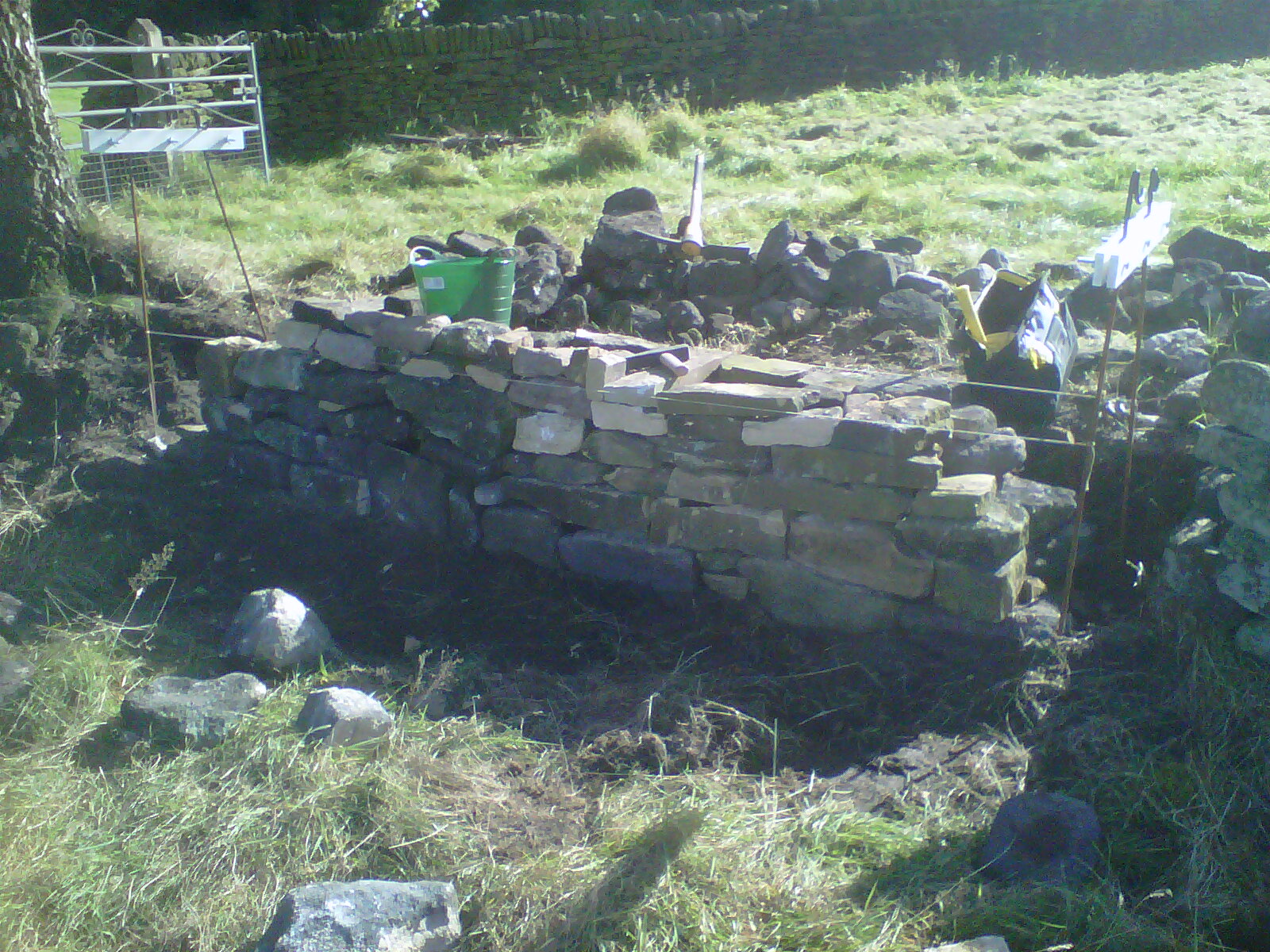
Well, four days in – actually four half days – and this is how far I have got.  And I keep thinking the next time I come here, I will reach the top (the top is just underneath the white wooden clamps). So I reckon that I am about half way up. Mmmm. 

Day four – and about half height

To be fair, there have been a few distractions the last few days and today was no exception.  With the plan to put sheep on the bottom field, we had to put up a temporary fence around the septic tank.  The wooden railway sleepers that cover the top of the tank are looking pretty rotten.  I am not sure that they will support the weight of a sheep, but I have no intention of finding out!

Temporary fence around the septic tank

I suspect that we will need to erect an electric fence around some of the field.  Although the walls and fence are (for the most part) in reasonable shape, they are a bit low in places.  Still, we will see.

Dry stone walling – Day 3

Well, it wasn’t really a whole day – just a morning as I got distracted.

I spent about 3 hours this morning dis-assembling and digging out the footings for another 2m stretch of wall.  I am being “less precise” with this stretch of the wall and doing the best I can with the current wall stone.  Yes, it is horrible and rounded, but for this field wall I am just going to have to do my best.  Shipping in huge amounts of new stone to build a field wall seems like a huge amount of wasted time and effort (not to mention money!).  I am hoping that by the end of this weekend that I will have at least part of the wall up to the finished height.  We will have to see.

Not much to look at for 2.5 days work.

I then faced two distractions in the afternoon.  Firstly, measuring out where the new extension will be and marking this out on the ground.  I haven’t got an electronic version of the plans, so haven’t had chance to post them here yet. Jo is concerned that you will be able to see into the master bedroom from the road.  I took the new plans that we have and used road pins to mark out where the master bedroom is going to be.  This was a useful exercise.  We now know that it will be very difficult to see into the bedroom from road level.  And if we are still in any doub, a small dry stone wall on the crest of the rise would totally block the view from the road.

The second distraction was cutting the grass on the top field.  Rob kindly brought his tractor (and daughter – Ellie) to help with the job.  It took about an hour or so to cut the grass.  Strangely, it has a tendency to find all the stones in the field!  This slowed progress, but I now think that the majority of the loose stones have been removed.  We will have to see.  This is the last time that the field will have to be cut this year.


Rob showing the grass whose boss!
Rob and Ellie – Houston we have a problem!

The lower field has a lot more of slope, so the current plan is to graze some sheep in the lower field to get the grass down to more of a manageable level.  We just need to find out where we can borrow some sheep from!


VAT questions – answered

We asked our friendly VAT consultant (Stephen Fennell) for some advice and got the following clarification on the questions we had on VAT issues.  If you have questions around VAT, you can reach Stephen via his website: www.sef-vatconsultants.co.uk.

1.       Given that we are converting two cottages into one, I assume that we are eligible for the reduced rate of VAT (currently 5%).  Is this correct?
This is correct and further info can be found in Section 7 of 708. You can find the document here: http://customs.hmrc.gov.uk/channelsPortalWebApp/downloadFile?contentID=HMCE_CL_000513

2.       We are converting the barn on the end of the property into residential use.  This attracts a VAT rate of 0%.  Is this correct?
If a Builder is undertaking the work for you he would charge Vat at the reduced rate of 5% but if you were undertaking the work yourself you would be able to reclaim all of the Vat expenses on materials via the DIY Housebuilder Scheme

3.       When converting the barn, it will be extended.  What rate of VAT applies to this element of the build?
This would be deemed to be part & parcel of the barn conversion and follow the same vat line (reduced rate 5%)

4.       The proposal is to build a triple garage with home office space above.  What level of VAT will this attract?
If this were part of a ‘new build’ of a domestic dwelling the construction of the garages would be zero rated as per the domestic dwelling so adopting the same principles if the garages are constructed as part of the conversion process there is an argument that they could be supplied at the reduced rate of 5%. However the Vat man/woman may well argue differently and insist that the build of a non domestic stand alone building should be standard rated at 20% Vat. Your builder may have an opinion on this but just to be sure we could apply for a categoric ruling from HMRC.

5.       If different parts of the build (even if completed at the same time), attract different levels of VAT how is this handled?
The builder would be obliged to provide separate ‘Tax Invoices’ to show the work undertaken & the relevant vat rate applied.

6.       If we qualify for the reduced rate of VAT, we have to prove this to our build who will then only charge us at the reduced rate.  What form of evidence will satisfy HM revenues and custom?
The ‘onus’ is on the builder to provide the relevant evidence as to the correct Vat liability and this is usually in the form of planning consent, plans & correspondence from the Land Registry. In truth a Vat Inspector would loook at the narrative on the builder’s invoices to you and form his/her own opinion as to whether the builder has applied the correct Vat liability and then take issue with the builder if there is any doubt.
 

7.       Certain energy saving technology has a VAT rate of 0%.  How is this handled when dealt with via the main contractor?
As mentioned above i’ve attached PN 708/6 Energy Saving Materials for your information and this gives a comprehensive outline of the Vat treatment of the various energy saving technologies and their treatment for Vat purposes. Much depends on whether the they are being provided as anxcillary to the major supply or whether they are the major supply. The Public Notice seems to cover every eventuality & scenario.

Dry stone walling: Day 2

Well after the progress made yesterday – wall dismantled, foundations dug and first course laid – today was somewhat disappointing.  Disheartening even.  In 4 hours, I managed 6 or so courses and the 2m section of wall I was working on reached about 0.5m, maybe less.  The main problem (besides my lack of skill) is that most of the stones that make up the wall are pretty much rounded boulders.  The rock is made up of very coarse gritstone which is very soft and crumbly – you could try and shape it with a hammer, but that is going to be real hard work.

Setting out the new section of wall


So what do you do? In short, no idea.  Looking at the surrounding fields, the same problem is present – walls (or what used to be walls) made up of rounded gritstone.  There are some walls on the property that are made from a much finer sandstone and the stones here are much flatter with defined angles.  I would imagine that the stone for these walls has been brought in from elsewhere, but probably not too far away.
Option 1: Bring in building stone and remove the old boulders.  This isn’t going to work.  The new stone would cost a fortune to buy on this sort of scale, plus what would you do with the old stone?  This seems like a sledge hammer to crack a nut.
Option 2: Rebuild the wall using the existing gritstone.  Improving the wall isn’t going to be hard as part of it has fallen down and even if it hadn’t, it could do with being straight!  It won’t be perfect, or pretty for that matter, but it will do the job.  Since the wall does have some building material in it, I could sort these stones out and use them to repair some of the walls nearer to the house. 


Not much for two days work – a (very small) wall and a lot of left over boulders


As far as I can see, Option 2 is the only real practical solution.  I could do with getting some advice from someone with a lot more experience than me.  Just in case I am missing something obvious – it is a lot of work for some to then point out that there was an easier solution!

The next step has to be looking at the other field walls and finding a section that is relatively intact.  This will give an idea of the size and proportion of the walls.  I can then see if we can build something that is similar.  Ho hum.

« Older posts Newer posts »

© 2025 Hagg Leys Farm

Theme by Anders NorenUp ↑